
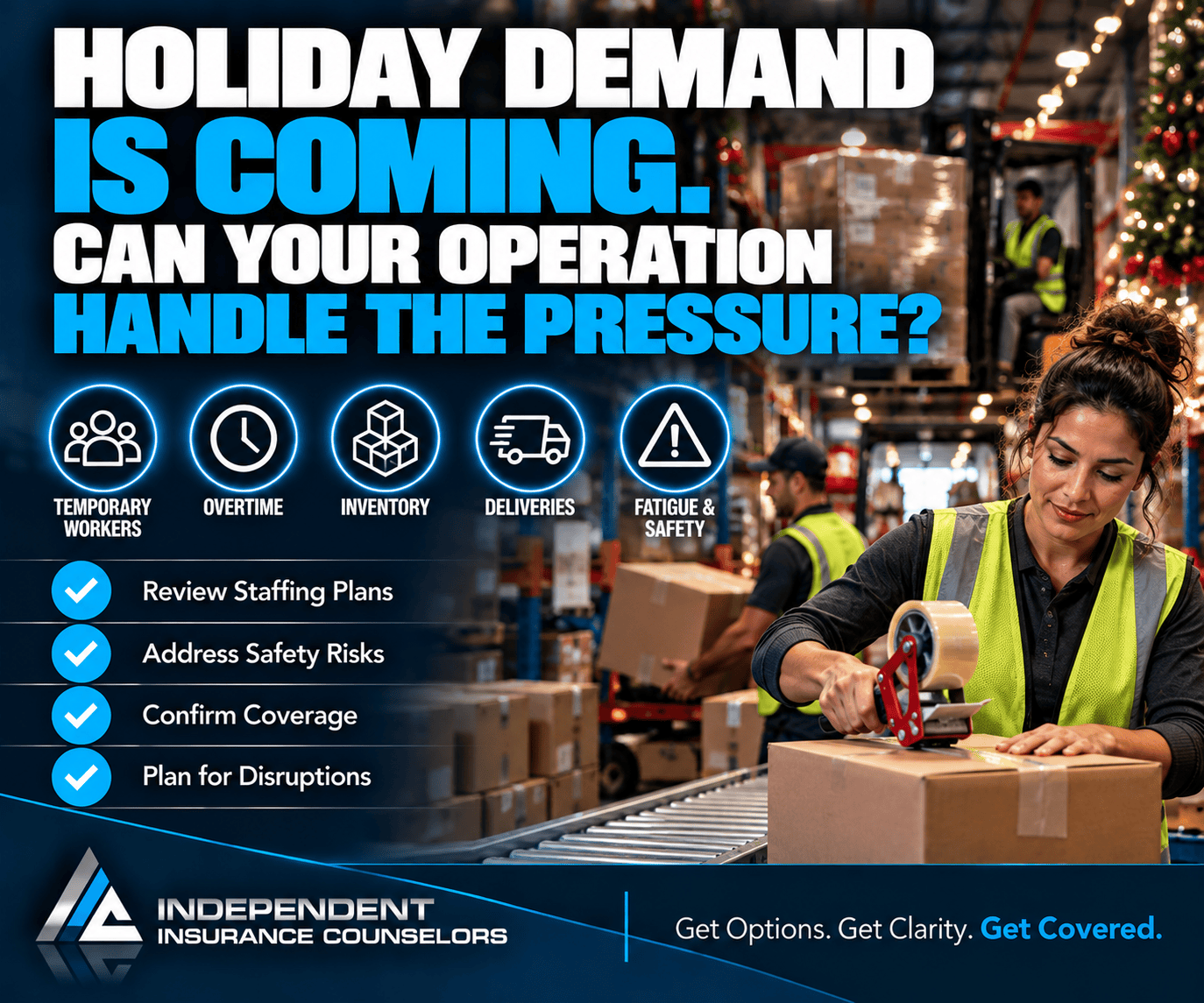
More customers and more revenue are good problems to have. But holiday demand can also mean temporary workers, overtime, rushed training, heavier inventory, more deliveries and less room for error.
For many businesses, the holiday season does not simply mean more sales.
It means more of almost everything.
-
More customers.
-
More inventory.
-
More deliveries.
-
More overtime.
-
More temporary employees.
-
Longer hours.
-
Tighter deadlines.
That is good news—until the operation is asked to do more than its normal systems were designed to handle.
Holiday risk rarely comes from one dramatic decision. It comes from pressure.
A process that works well at normal volume becomes rushed. A new employee receives less training because the team is busy. A delivery gets squeezed into an already full schedule. Inventory gets stacked wherever there is room. A manager works another late night.
Each shortcut seems reasonable in the moment.
Together, they can increase the chance of an accident, injury, customer complaint, property loss or costly mistake.
Before the busiest weeks arrive, give your operation a stress test.
1. What Happens When Volume Jumps?
Think about the busiest realistic day of the season. Not an average day. A difficult one.
-
What happens if customer traffic doubles?
-
If orders arrive faster than employees can process them?
-
If inventory fills normal storage areas?
-
If several employees call out?
-
If a supplier misses a delivery?
Identify where the operation is most likely to bottleneck.
Then decide in advance what the team should do when capacity is reached.
“Work faster” is not a continuity plan.
2. Are Temporary and Seasonal Employees Actually Ready?
Seasonal workers can be essential. They can also arrive when experienced employees have the least time to train them.
Do not let urgency erase onboarding.
Before a temporary employee starts working independently, determine what training the job requires.
That may include:
-
Safety procedures
-
Equipment operation
-
Customer interaction
-
Cash handling
-
Cybersecurity practices
-
Vehicle-use rules
-
Incident reporting
-
Emergency procedures
A worker who will only be there for six weeks still needs to know how your company expects the job to be done.
Also make sure employment status, payroll and job duties are accurately communicated to the appropriate insurance and professional advisers when relevant.
3. Watch Overtime and Fatigue
Longer hours can solve a staffing problem while creating another kind of risk.
Fatigue affects attention, reaction time and decision-making.
That matters for employees operating vehicles, machinery, tools or performing physical work.
Managers should pay attention to scheduling, breaks, workload and signs that the team is being asked to sustain an unrealistic pace.
Wage-and-hour requirements can also become more complicated when schedules change. Businesses should maintain accurate timekeeping and seek qualified HR or legal guidance when questions arise.
4. More Inventory Means More Value at Risk
Holiday inventory can change quickly.
-
A retailer may carry significantly more merchandise than usual.
-
A distributor may bring in extra stock.
-
A contractor may purchase materials in advance to avoid seasonal delays.
If inventory values rise substantially, ask whether the limits and valuation methods in the insurance program still make sense.
Some commercial property policies may include seasonal or peak-season provisions, while others may require different limits or endorsements. Policy terms vary.
Do not assume the amount that works in July automatically works in December.
5. More Deliveries Mean More Driving Exposure
Busy seasons create movement.
-
Employees make extra trips.
-
Delivery routes get longer.
-
Temporary drivers may be added.
-
Personal vehicles may be used for errands.
-
Drivers may feel pressure to complete one more stop.
Review who is authorized to drive, what vehicles they may use and what the company expects regarding distracted driving, accident reporting and vehicle inspections.
If employees use personal vehicles for business purposes, discuss that exposure with your insurance adviser as well.
6. Customer Traffic Can Change the Physical Space
More people inside the business can create practical safety issues.
-
Are entrances clear?
-
Are walkways blocked by displays or inventory?
-
Are cords, boxes or seasonal decorations creating trip hazards?
-
Can employees see congested areas?
-
Are parking lots and loading areas becoming more crowded?
A temporary display should not create a permanent claim.
Walk through the property as a customer would—especially during the busiest part of the day.
7. Holiday Decorations Still Need Ordinary Safety Rules
Decorations can make a workplace welcoming.
They can also introduce extension cords, electrical loads, candles, blocked exits or combustible materials.
Keep exits and fire equipment accessible. Use electrical products as intended. Avoid creating trip hazards or overloading outlets.
The festive season does not suspend ordinary safety practices.
8. Cybercriminals Like Busy Employees Too
High-volume periods can create ideal conditions for phishing and payment fraud.
Employees are processing more orders, more invoices, more shipping notices and more customer messages.
A fraudulent email that might look unusual in March may blend into the noise in November.
Remind employees to slow down around:
-
Password-reset requests
-
Changes to vendor banking information
-
Urgent payment requests
-
Unexpected attachments
-
Gift-card requests
-
Shipping notifications
-
Login links
Pressure is exactly when verification procedures matter most.
9. What If a Key Employee Is Missing?
Holiday schedules can leave businesses thin.
Vacation, illness or family obligations may remove the person who normally handles an important function.
Ask:
-
Who can approve payroll if the usual person is out?
-
Who knows the alarm code?
-
Who can contact the software provider?
-
Who can handle a customer escalation?
-
Who has vendor information?
-
Who knows the shutdown procedure?
Cross-training is not just an HR benefit. It is business continuity.
10. Review Insurance Before the Rush, Not After It
Seasonal changes may affect several parts of a commercial insurance program, including property values, payroll, workers’ compensation classifications, vehicle use and business interruption exposures.
Coverage depends on the actual policy, endorsements, limits, exclusions and circumstances.
The useful question is not simply: “Are we insured for the holidays?”
Ask instead:
“What is changing in our operation during the holidays, and does our insurance program reflect those changes?”
Run a 30-Minute Holiday Stress Test
Gather the people responsible for operations, staffing, safety and finances.
Ask five questions:
-
Where will volume increase the most?
-
Where are we most likely to take shortcuts?
-
Which employees or vendors are critical?
-
What values—inventory, payroll or vehicle use—will temporarily increase?
-
What would hurt us most if it failed during our busiest week?
You do not need a complicated report.
Write down the answers and assign an owner to the issues that deserve attention.
The goal is not to eliminate the holiday rush.
The goal is to make sure growth in demand does not outrun the systems supporting it.
At Independent Insurance Counselors, we help Texas business owners think through the operational changes behind their insurance—not just the policy itself.
A busy season should create opportunity.
Make sure it does not create avoidable surprises.
Get Options. Get Clarity. Get Covered.