When business owners think about insurance claims, they often picture physical damage.
-
A building fire.
-
A hurricane.
-
A vehicle accident.
-
A broken piece of equipment.
-
Something visible.
-
Something obvious.
-
Something tangible.
But some of the most financially damaging losses a business can experience involve something much less visible:
-
Lost income.
-
A business may survive a property claim.
-
What often proves more difficult is surviving the interruption that follows.
-
Payroll continues.
-
Rent continues.
-
Loan payments continue.
-
Utilities continue.
-
Customers disappear.
-
Revenue slows.
-
Cash flow tightens.
And suddenly, the biggest problem isn’t repairing the damage.
It’s replacing the income.
That’s where business interruption coverage enters the conversation.
Unfortunately, it’s also one of the most misunderstood areas of commercial insurance.
What Is Business Interruption Coverage?
Business interruption coverage—sometimes called business income coverage—is designed to help replace lost income when a covered event disrupts normal operations.
The goal is simple:
Help the business maintain financial stability while recovering from a covered loss.
Coverage may help address:
-
Lost revenue
-
Continuing operating expenses
-
Payroll obligations
-
Temporary relocation costs
-
Certain extra expenses incurred during recovery
For many businesses, this coverage can be just as important as property insurance itself.
After all, a repaired building doesn’t immediately restore lost revenue.
The Common Misconception
One of the most common assumptions business owners make is:
“If my building isn’t damaged, I don’t have a business interruption exposure.”
The reality is much more complicated.
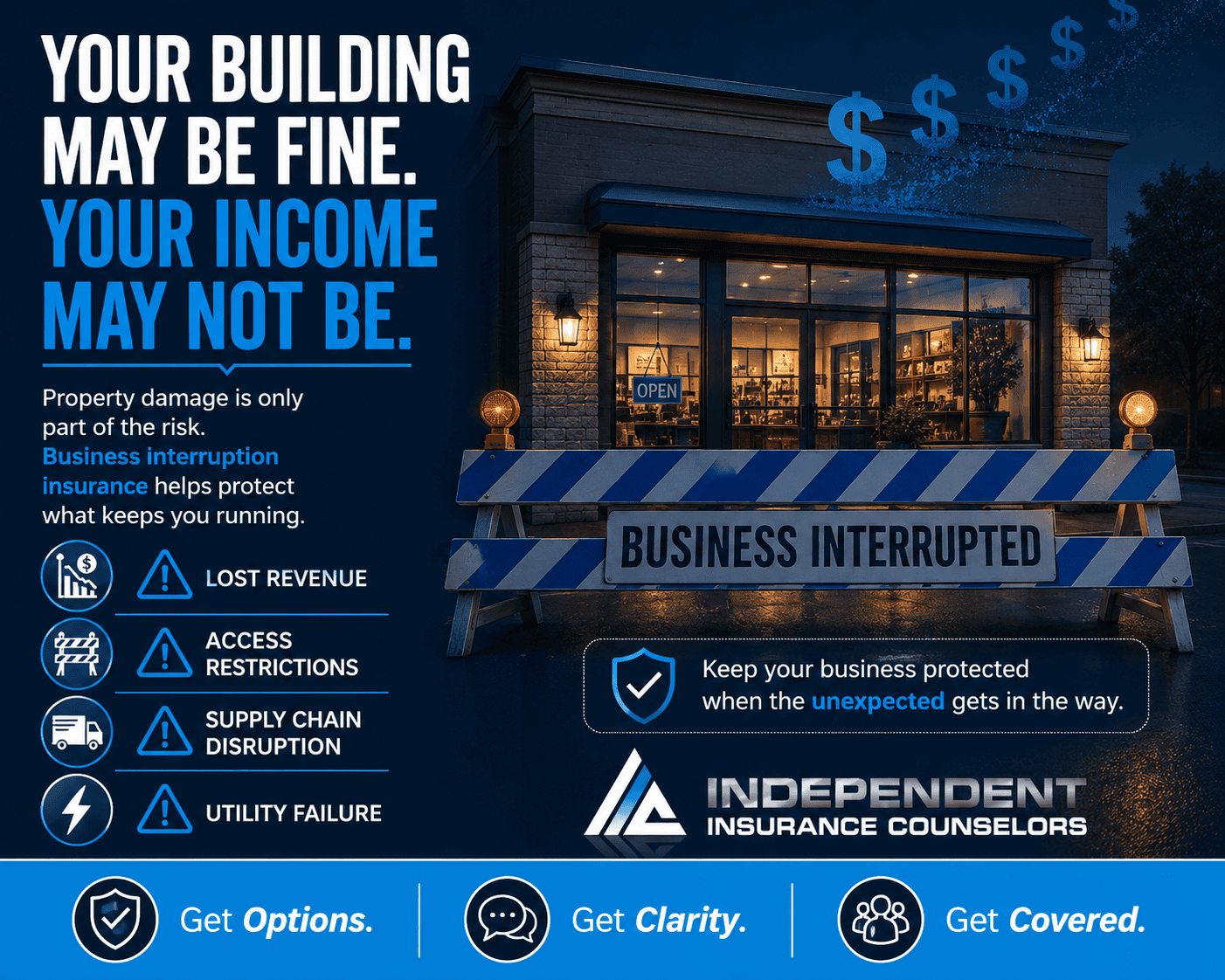
Businesses can lose income for many reasons.
Sometimes those losses occur without direct damage to the business itself.
That’s why understanding policy triggers is so important.
Civil Authority Shutdowns
Imagine your building is completely unharmed.
-
No fire.
-
No storm damage.
-
No structural issues.
-
But local authorities close nearby roads after a major incident.
-
Customers can’t access your location.
-
Employees can’t get to work.
-
Operations slow or stop entirely.
This type of situation may trigger what’s commonly known as civil authority coverage, depending on policy wording and circumstances.
Many business owners are surprised to learn that access restrictions can create financial losses even when their own property remains intact.
Utility Service Interruptions
Consider another scenario.
A severe summer storm damages a utility provider’s equipment several miles away.
Your building suffers no direct damage.
However, power is unavailable for days.
-
Operations stop.
-
Inventory spoils.
-
Revenue disappears.
Coverage for utility service interruptions often depends on specific policy provisions and endorsements.
Many businesses don’t realize these distinctions until after a claim occurs.
Supply Chain Disruption
Modern businesses depend heavily on suppliers, manufacturers, distributors, and vendors.
When one link in that chain fails, multiple businesses may be affected.
A supplier’s loss can become your loss.
A transportation disruption can affect inventory.
A manufacturing delay can affect customer commitments.
These scenarios may fall into areas often referred to as contingent business interruption exposure.
Not every policy addresses these situations the same way.
Understanding how your policy responds is essential.
Time Is Often More Important Than Damage
Many business owners focus on the severity of a physical loss.
Insurance professionals often focus on something else:
Recovery time.
A relatively small property claim that interrupts operations for months can create more financial damage than a larger loss that is resolved quickly.
Questions worth considering include:
-
How long would operations be affected?
-
How quickly could customers return?
-
Could employees continue working?
-
Would vendors remain available?
-
How long could the business operate without revenue?
These questions often reveal vulnerabilities that aren’t immediately obvious.
Why Mid-Year Is the Perfect Time for This Conversation
Summer is an ideal time to evaluate business interruption exposure.
Businesses are operating.
Revenue patterns are visible.
Operational dependencies are easier to identify.
And there is still time to make adjustments before renewal season arrives.
A proactive review often reveals:
-
Coverage opportunities
-
Operational vulnerabilities
-
Vendor dependencies
-
Recovery planning gaps
The goal isn’t creating fear.
The goal is creating clarity.
Income Is One of Your Most Valuable Assets
Most businesses insure buildings.
Most insure vehicles.
Most insure equipment.
But many underestimate the importance of protecting the revenue those assets generate.
Business interruption coverage exists because income is often the most valuable asset a company possesses.
Understanding how that protection works before a loss occurs helps businesses make better decisions and recover more effectively when disruptions happen.
At Independent Insurance Counselors, we help Texas businesses understand not only what their policies cover—but how those policies fit into the broader picture of risk management and business continuity.
Because sometimes the biggest loss isn’t physical damage.
It’s the income that disappears afterward.
If Revenue Stopped Tomorrow, How Long Could Your Business Operate?
Business interruption coverage can be one of the most valuable—and most misunderstood—parts of a commercial insurance program.
We’re happy to help you understand how your policy responds, identify potential gaps, and review your business income exposure.
📞 Call: (281) 331-3131
📱 Text: (281) 978-4775
🌐 Visit: insurancetexas.net
Get Options. Get Clarity. Get Covered.