Certificates of Insurance (COIs) are one of the most commonly used—and most misunderstood—documents in commercial insurance.
They are requested on nearly every project, required in most contracts, and often treated as proof that risk has been properly transferred or protected. But in reality, a COI does far less than many businesses believe.
At its core, a Certificate of Insurance serves a very simple purpose:
It confirms that an insurance policy existed at a specific moment in time.
That’s it.
It does not guarantee that coverage will apply to a specific claim. It does not override exclusions within the policy. It does not confirm that limits are sufficient for the exposure involved. And it does not ensure that required endorsements—such as additional insured status—have actually been added correctly.
This is where the risk begins.
Many businesses rely on COIs as if they are a form of protection, especially when working with subcontractors, vendors, or partners. A certificate is collected, filed away, and assumed to represent a transfer of risk. Then, when a claim occurs, the expectation is that the other party’s insurance will respond.
However, claims are not evaluated using certificates.
They are evaluated using the actual policy language.
If the policy excludes the type of work being performed, the claim may be denied. If limits are insufficient, they may be exhausted quickly. If required endorsements were never issued, coverage may not extend to the requesting party at all.
This disconnect between expectation and reality is what creates costly surprises.
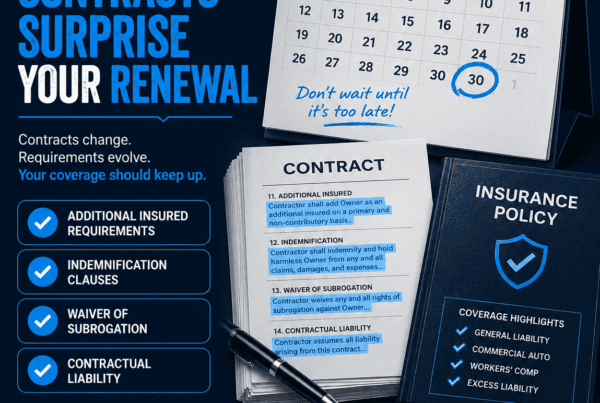
Another common issue involves additional insured status. Many contracts require one party to be added as an additional insured on another party’s policy. While a COI may indicate that this has been done, it does not confirm the scope, wording, or limitations of that endorsement. Some additional insured endorsements provide broad protection, while others are narrow and highly conditional.
Without reviewing the endorsement itself, businesses are often operating on assumptions.
Certificates of Insurance should be viewed for what they are:
administrative tools—not risk management solutions.
They are useful for verifying that coverage exists, but they are not a substitute for understanding how that coverage actually works.
True protection comes from:
-
Reviewing policy forms and endorsements
-
Confirming limits align with real-world exposure
-
Understanding how coverage applies in contractual relationships
-
Ensuring endorsements are properly issued and documented
In practice, this means going beyond the certificate and asking deeper questions before relying on another party’s insurance—or assuming your own policy will respond in a certain way.
Insurance works exactly as written, not as assumed.
Clarity before a claim occurs is what separates businesses that are prepared from those that are surprised.
If your business regularly relies on Certificates of Insurance—or provides them—we’re happy to help you understand what they confirm and where potential gaps may exist. A quick review can provide clarity before a situation turns into a claim.
 (281) 331-3131