For many businesses, insurance renewal season follows a familiar pattern.
A renewal proposal arrives.
Coverage is reviewed.
Premiums are evaluated.
Questions are asked.
Decisions are made.
Unfortunately, this is also when many businesses discover insurance issues that should have been identified months earlier.
One of the most common examples involves contracts.
A company signs agreements throughout the year.
Projects begin.
Vendor relationships develop.
New customers are onboarded.
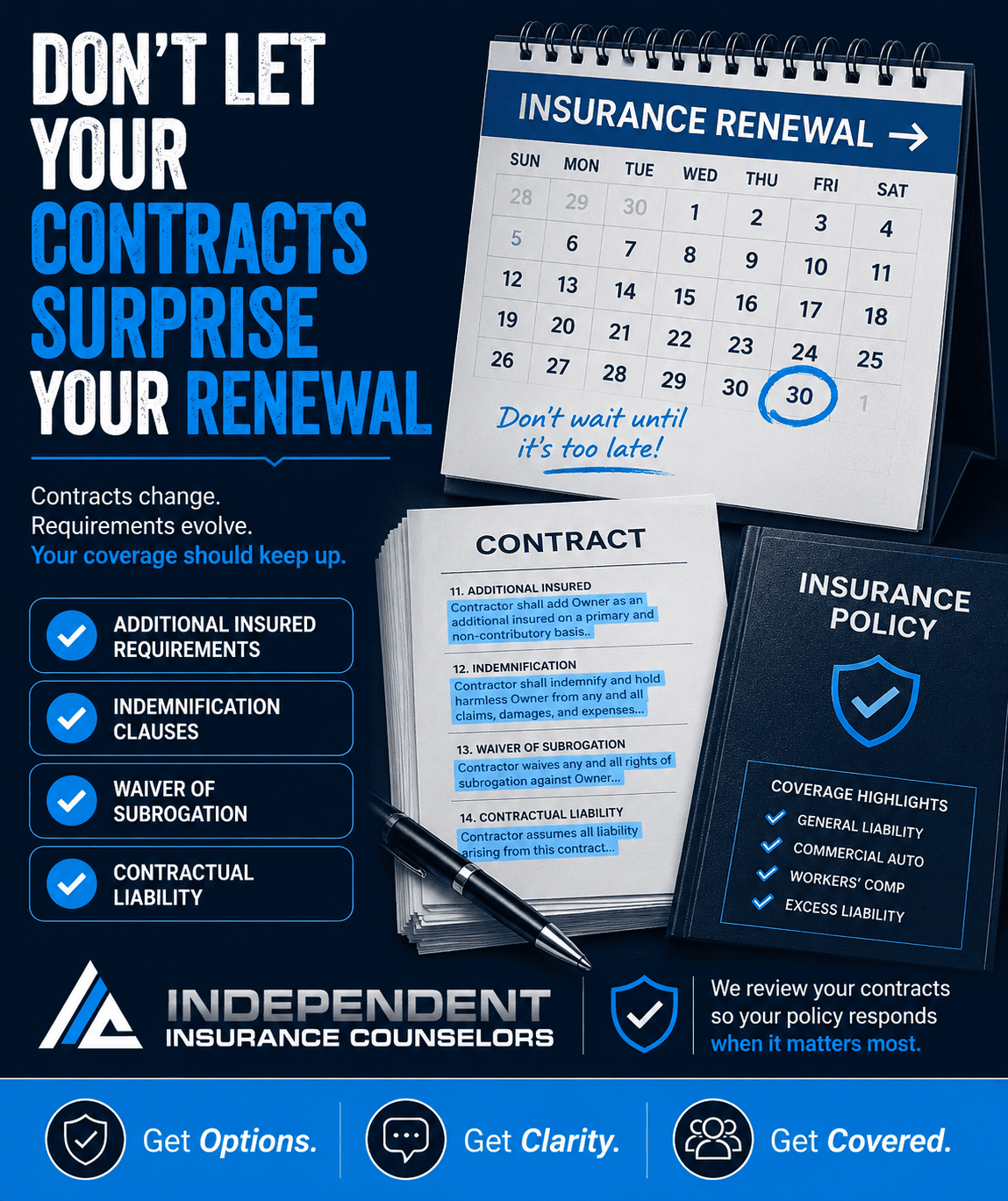
Additional insured requirements are accepted.
Indemnification language is agreed to.
Certificates of Insurance are exchanged.
Then renewal season arrives and someone finally asks:
“Does our insurance actually support everything we’ve agreed to?”
Sometimes the answer is yes.
Sometimes the answer is expensive.
The good news is that these problems are much easier to address before renewal season than during it.
Why Contracts Create Insurance Exposure
Contracts are one of the fastest ways a business can assume additional liability.
Many business owners think of insurance as the primary source of risk.
In reality, contracts often determine where that risk ultimately lands.
Insurance finances risk.
Contracts transfer it.
The challenge is that contracts are frequently signed by operational teams, project managers, executives, or department leaders who may not fully understand the insurance implications of certain provisions.
Over time, those obligations accumulate.
Eventually, they affect underwriting, coverage requirements, and renewal discussions.
Additional Insured Requirements Continue to Grow
Many contracts require one party to add another as an additional insured.
This has become standard practice across numerous industries.
Construction.
Property management.
Professional services.
Manufacturing.
Transportation.
Healthcare.
The issue isn’t necessarily the requirement itself.
The issue is understanding what was requested, what was provided, and whether the policy actually supports the obligation.
Businesses often discover during renewal that additional insured requirements have become more complex than originally anticipated.
A proactive review provides time to address those concerns before underwriters begin evaluating the account.
Indemnification Clauses Deserve Attention
Many business owners underestimate the impact of indemnification language.
These provisions determine who assumes responsibility when claims occur.
Some indemnification clauses are balanced and reasonable.
Others shift substantial liability from one party to another.
A business may unknowingly accept obligations that exceed the protection provided by its insurance program.
This disconnect often becomes visible during claims—or during renewal discussions.
Neither is an ideal time for discovery.
Waivers of Subrogation Matter More Than Many Realize
Waivers of subrogation frequently appear in commercial contracts.
They often seem routine.
However, these provisions can affect recovery rights after a claim occurs.
Some policies accommodate these requirements automatically.
Others require endorsements.
Some carriers evaluate these provisions differently than others.
Understanding what has been agreed to allows businesses to prepare before renewal negotiations begin.
Renewal Season Creates Less Flexibility
The biggest reason to review contracts before renewal is simple: Time.
When issues are discovered months in advance, businesses typically have options.
Coverage can be adjusted.
Endorsements can be requested.
Underwriting discussions can occur.
Alternative solutions can be explored.
When issues are discovered two weeks before renewal, flexibility often disappears.
Deadlines create pressure.
Pressure limits choices.
Questions Businesses Should Ask Right Now
Before renewal season arrives, consider:
-
Have new contracts been signed this year?
-
Are additional insured requirements increasing?
-
Have indemnification obligations changed?
-
Are certificates being collected consistently?
-
Does current coverage align with contractual responsibilities?
-
Have operational changes affected exposure?
The answers frequently reveal opportunities for improvement.
Renewal Planning Is Risk Management
The most successful renewals rarely happen because someone worked harder at the last minute.
They happen because planning started earlier.
Businesses that review contracts proactively often experience:
-
Smoother renewals
-
Fewer surprises
-
Better underwriting conversations
-
More coverage options
-
Stronger risk management outcomes
Insurance works best when it supports the business strategy—not when it reacts to it.
The Best Time to Fix a Problem Is Before It’s a Problem
Contract-related exposures rarely appear overnight.
They develop gradually through business growth, customer requirements, and operational changes.
The sooner those obligations are identified, the easier they are to address.
At Independent Insurance Counselors, we help Texas businesses review insurance requirements, contractual obligations, and risk management strategies before renewal season arrives.
Because renewal shouldn’t be the first time important questions are asked.
Are Your Contracts Creating Renewal Problems You Haven’t Discovered Yet?
If your business regularly signs contracts, works with vendors, manages subcontractors, or accepts additional insured requirements, now is an excellent time for a proactive review.
We’ll help evaluate how your insurance program aligns with your contractual obligations before renewal season arrives.
📞 Call: (281) 331-3131
📱 Text: (281) 978-4775
🌐 Visit: insurancetexas.net
Get Options. Get Clarity. Get Covered.