For many businesses, vehicles are essential tools.
Contractors rely on trucks to move crews and equipment.
Service companies depend on technicians reaching customer locations.
Sales teams spend significant time on the road.
Delivery businesses operate almost entirely behind the wheel.
The challenge is that every vehicle represents more than transportation.
Every vehicle represents liability.
And for many businesses, commercial auto exposure is one of the largest risks they face.
A single serious accident can create costs far beyond vehicle repairs.
-
Medical expenses.
-
Legal fees.
-
Lost productivity.
-
Reputation damage.
-
Increased insurance premiums.
-
Business disruption.
-
In severe cases, a single claim can affect a company for years.
That’s why fleet safety should never be viewed as simply a transportation issue.
It’s a risk management issue.
Commercial Auto Claims Continue to Grow
Over the past several years, commercial auto claims have become more expensive.
Vehicle repair costs have increased.
Medical expenses continue to rise.
Litigation has become more aggressive.
Settlement amounts have grown substantially.
This trend affects businesses of every size.
Many business owners are surprised to learn that relatively minor accidents can generate significant claim costs when injuries are involved.
The financial impact often extends well beyond the initial loss.
Insurance Is Not the First Line of Defense
Insurance plays an important role.
But insurance is designed to respond after a claim occurs.
The strongest risk management strategies focus on preventing claims before they happen.
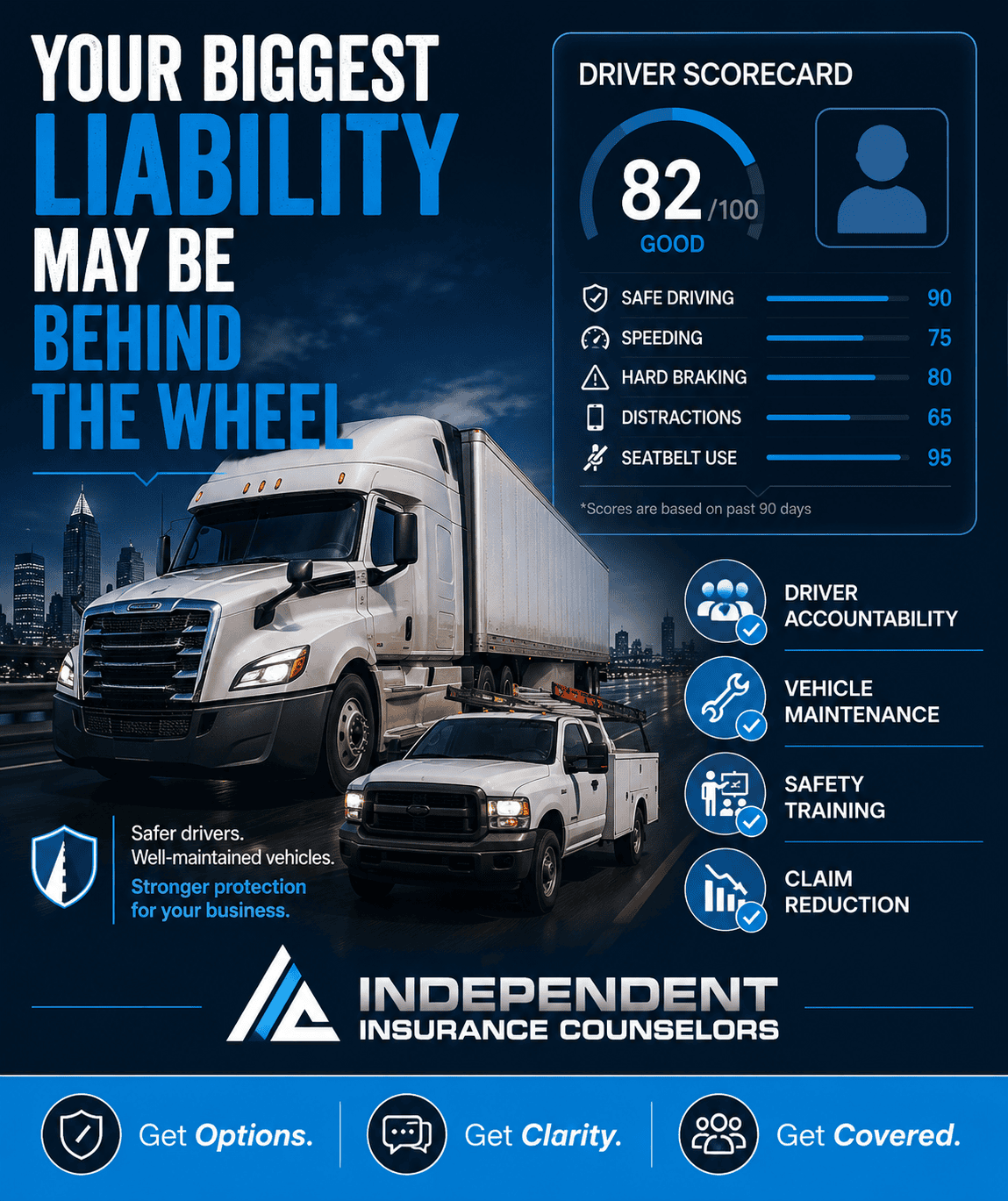
That begins with driver accountability.
The Human Factor
Most commercial auto claims involve human behavior.
-
Distraction.
-
Speeding.
-
Fatigue.
-
Poor decision-making.
-
Complacency.
-
Unsafe driving habits.
Even experienced employees can develop risky behaviors over time.
Without oversight and accountability, those habits often go unnoticed until an accident occurs.
Driver Accountability Starts with Expectations
Businesses that experience fewer vehicle-related claims often establish clear expectations.
These may include:
-
Seatbelt requirements
-
Cell phone policies
-
Vehicle inspection procedures
-
Reporting requirements
-
Driver qualification standards
-
Accident response protocols
Employees perform better when expectations are clearly communicated.
Consistency matters.
Accountability matters.
Documentation matters.
Driver Selection Matters More Than Many Businesses Realize
Not every employee should operate a company vehicle.
Businesses should consider reviewing:
-
Motor Vehicle Records (MVRs)
-
Prior driving history
-
License status
-
Accident history
-
Driving-related violations
Many preventable losses begin with driver issues that could have been identified before an employee was placed behind the wheel.
Vehicle Maintenance Is Safety Management
Mechanical failures create liability.
A poorly maintained vehicle may contribute to:
-
Brake failures
-
Tire blowouts
-
Steering issues
-
Lighting problems
-
Equipment malfunctions
Routine maintenance helps reduce these exposures.
It also demonstrates a commitment to safety should litigation occur after an accident.
Technology Is Changing Fleet Safety
Today’s businesses have access to tools that were unavailable just a few years ago.
Examples include:
-
GPS tracking
-
Driver monitoring systems
-
Dash cameras
-
Telematics programs
-
Fleet management software
These tools can help identify risky behaviors before they lead to claims.
More importantly, they provide data that allows businesses to coach and improve driver performance.
Safety Culture Matters
The most successful fleet safety programs aren’t built around punishment.
They’re built around culture.
When safety becomes part of everyday operations, employees begin viewing vehicle safety as a shared responsibility.
That cultural shift often produces better results than policies alone.
Questions businesses should ask include:
-
Do drivers understand expectations?
-
Are incidents reviewed consistently?
-
Is safety discussed regularly?
-
Are positive behaviors reinforced?
Small improvements often lead to meaningful long-term results.
The Insurance Connection
Fewer claims often create benefits beyond safety.
Businesses with strong fleet management practices may experience:
-
Better loss histories
-
Improved underwriting outcomes
-
More favorable insurance options
-
Greater long-term stability
Insurance carriers pay close attention to how businesses manage vehicle exposure.
Strong controls frequently lead to stronger insurance opportunities.
Fleet Safety Is Business Protection
Commercial vehicles are often among a company’s most visible assets.
They’re also among its largest liability exposures.
Protecting employees, customers, and the business itself requires more than insurance.
It requires planning.
Training.
Accountability.
And a commitment to continuous improvement.
At Independent Insurance Counselors, we help Texas businesses evaluate commercial auto exposures and identify opportunities to strengthen their overall risk management strategy.
Because the best claim is the one that never happens.
How Strong Is Your Fleet Safety Program?
If your business operates company vehicles or has employees driving for work, now is a great time to review your commercial auto exposure and risk management practices.
We’re happy to help evaluate your coverage and discuss strategies that may help reduce claims and strengthen protection.
📞 Call: (281) 331-3131
📱 Text: (281) 978-4775
🌐 Visit: insurancetexas.net
Get Options. Get Clarity. Get Covered.