A business does not have to suffer physical damage to face a serious interruption. If a critical supplier, software provider, payment processor or utility fails, your operation may stop with it.
Imagine arriving at work tomorrow and discovering that your building is fine.
-
Your employees are ready.
-
Your equipment works.
-
Your customers are calling.
-
Nothing has been stolen.
-
There was no fire, storm or accident at your location.
But you still cannot operate.
Why? The vendor your business depends on cannot deliver.
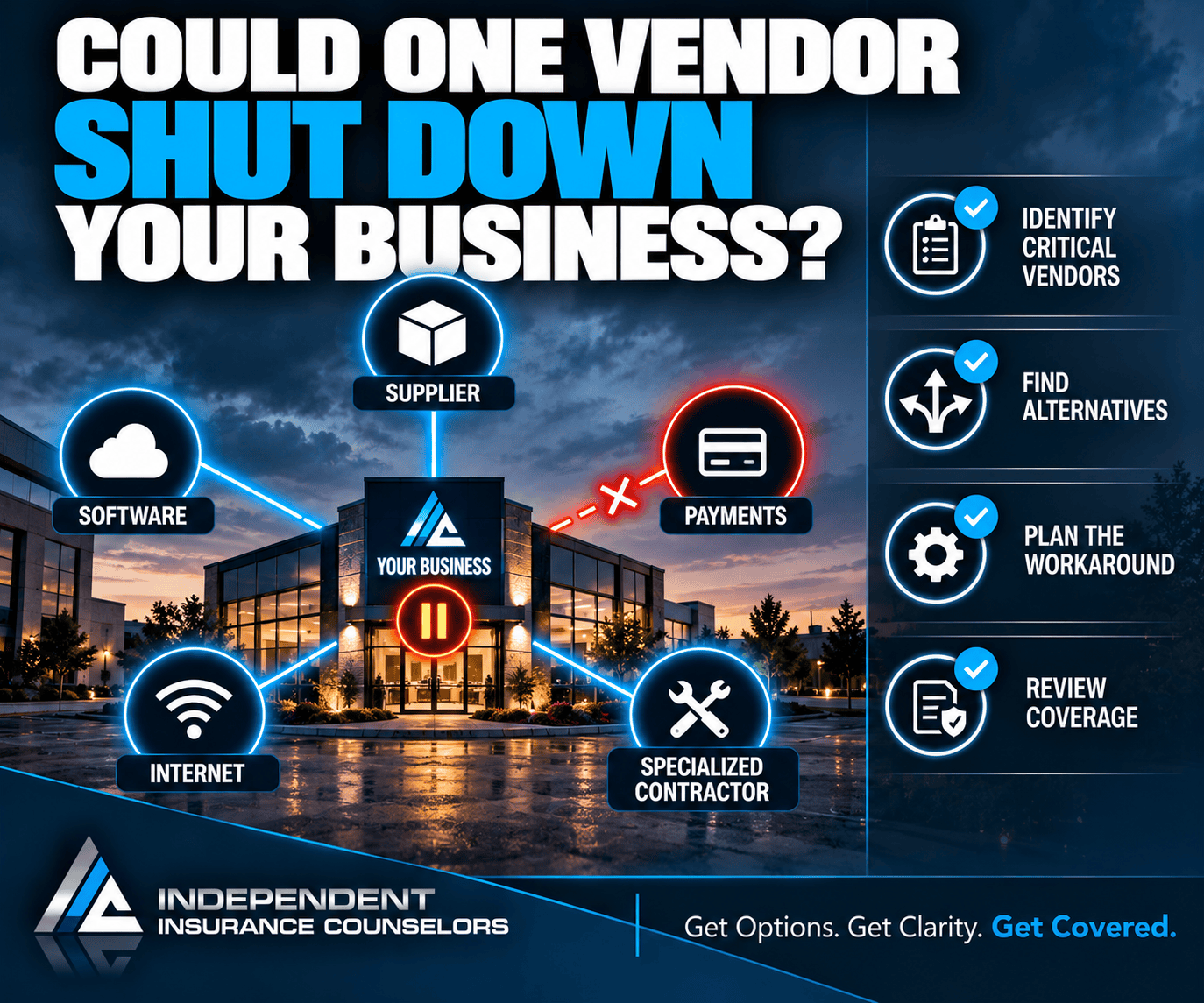
That vendor might be:
-
A manufacturer supplying a critical component.
-
It might be the software platform that runs your scheduling.
-
Your payment processor could be offline.
-
Your internet provider could have a major outage.
-
A specialized subcontractor may suddenly be unavailable.
Your company did not suffer the original problem. But your revenue can still suffer the consequences.
That is vendor dependency risk—and it is easy to underestimate because the exposure lives outside your four walls.
The Business You Don’t Own May Be Critical to the Business You Do
Most owners know their important customers.
Fewer have made a list of the outside organizations without which the company cannot function.
Consider:
-
Suppliers
-
Manufacturers
-
Distributors
-
Software platforms
-
Cloud providers
-
Payment processors
-
Internet and phone providers
-
Utilities
-
Payroll processors
-
Delivery companies
-
Specialized subcontractors
-
Equipment repair companies
Some are convenient. Others are operationally critical.
The difference is worth knowing before one disappears.
1. Identify Your Single Points of Failure
Start with one question:
Which outside company could stop or seriously disrupt our operation if it became unavailable tomorrow?
Do not limit the answer to physical suppliers.
-
A professional office might be more dependent on its practice-management software than any material vendor.
-
A retailer may depend heavily on a payment processor.
-
A contractor may have one supplier for a specialized component.
-
A manufacturer may rely on one machine-repair company with the expertise to service critical equipment.
-
A vendor becomes a concentration risk when there is no practical substitute—or when replacing it would take too long.
2. Ask How Long You Could Operate Without It
Not every outage becomes a crisis immediately.
If your primary office-supply vendor disappears, you can probably buy paper somewhere else.
If a sole-source component disappears, production might stop within hours.
For each critical vendor, ask:
How long could we continue without them?
-
An hour?
-
A day?
-
A week?
-
A month?
The shorter the window, the more attention the dependency deserves.
3. Know Whether an Alternative Actually Exists
“We could just use somebody else” sounds reassuring.
Have you tested that assumption?
-
A replacement supplier may require a new account, credit approval, minimum order, different specifications or weeks of lead time.
-
Alternative software may require data migration and training.
-
A new subcontractor may need contracts, certificates and onboarding.
-
A second vendor is only a backup if you can realistically use it.
For the most important dependencies, identify an alternative before the emergency.
4. Look Beyond Your Direct Vendor
Dependencies can extend another layer.
Your supplier may be reliable—but who supplies them?
-
Your software company may be operational—but what cloud infrastructure does it depend on?
-
Your delivery company may be functioning—but is a regional transportation disruption preventing deliveries?
You cannot map every company in the global economy.
You can ask important vendors about their own continuity plans, major dependencies and expected recovery processes.
5. Review Your Contracts and Service Agreements
When a vendor fails, owners often discover that their expectations and the contract are not the same thing.
Review important agreements for:
-
Service commitments
-
Outage procedures
-
Data ownership
-
Backup responsibilities
-
Termination rights
-
Recovery obligations
-
Liability limitations
-
Required insurance
For technology vendors in particular, understand how you retrieve your data if the relationship ends or the service becomes unavailable.
6. Protect Your Data From Vendor Failure
Cloud-based does not automatically mean risk-free.
Know what your critical providers back up and what you are responsible for backing up.
If possible, maintain appropriate exports or independent copies of information the business cannot recreate.
Customer lists, financial records, project information, schedules and operational documents can be difficult to rebuild after a provider failure.
7. Build the Vendor Into Your Business Continuity Plan
A continuity plan should not begin and end with evacuating your building.
For each critical dependency, document:
-
Primary vendor
-
Internal owner of the relationship
-
Vendor contact information
-
Backup vendor or workaround
-
Maximum tolerable downtime
-
Steps for switching
-
Customer communication plan
-
Insurance contact if a loss occurs
The objective is not a binder nobody opens.
It is a short playbook that saves time when the normal process stops working.
Where Insurance May Fit
Business interruption coverage is often discussed in connection with direct physical damage to the insured business, such as a covered fire.
Vendor-related interruptions can be more complicated.
Some commercial property programs may offer contingent business interruption or dependent-property coverage for certain losses involving specified suppliers, customers or other dependent locations. Coverage varies significantly and may depend on the cause of loss, the type or location of the dependent property, waiting periods, limits, endorsements and policy wording.
Cyber policies may also address certain interruptions involving technology providers, again depending on the facts and specific policy.
The important point is not to assume that “business interruption” automatically covers every vendor outage.
Ask specifically:
What happens under our policy if a critical vendor goes down?
That is a much more useful question.
Try the “One Vendor” Exercise
Gather your management team and ask everyone to write down one outside company they believe the business could least afford to lose.
Compare the answers.
If everyone writes the same name, you just identified a concentration risk.
If everyone writes a different name, you may have several dependencies worth examining.
Then ask:
-
How quickly would the loss affect us?
-
What is our alternative?
-
Who owns the response?
-
What insurance, if any, might apply?
You can learn a lot about business continuity in 20 minutes.
Resilience Extends Beyond Your Walls
A business can control its hiring, maintenance, safety procedures and internal systems.
It cannot control whether every outside partner stays operational.
What it can control is how dependent it becomes and how prepared it is for disruption.
At Independent Insurance Counselors, we help Texas businesses look beyond obvious property and liability exposures to the dependencies that can affect revenue and continuity.
Your building does not have to be damaged for your business to stop.
Sometimes the problem happens somewhere else.
Get Options. Get Clarity. Get Covered.